Crew, accreditation and equipment at Paradise City
As Paradise City grew, its team brought crew planning, accreditation and equipment into Eventication. This is their account of how the work changed.
Nick Verheyden describes the process at Paradise City, where he led operations until 2025. He is also a co-founder of Eventication; this story reflects that experience and relationship.
300 → 15Operational phone calls on a festival day, down from 200 to 300 to 10 or 15
10 secVolunteer payments included in one bank payment file
30+ hrsTime previously spent on volunteer email administration per edition
0Walkie-talkies unaccounted for, after years of losing 10 to 20 per edition
8xGrowth from 2,000 to 16,000 daily visitors since 2015
< 1 day2026 weekend and Saturday tickets sold out
700+Crew members managed in one system, plus close to 2000 supplier accreditation flows
The festival behind the castle
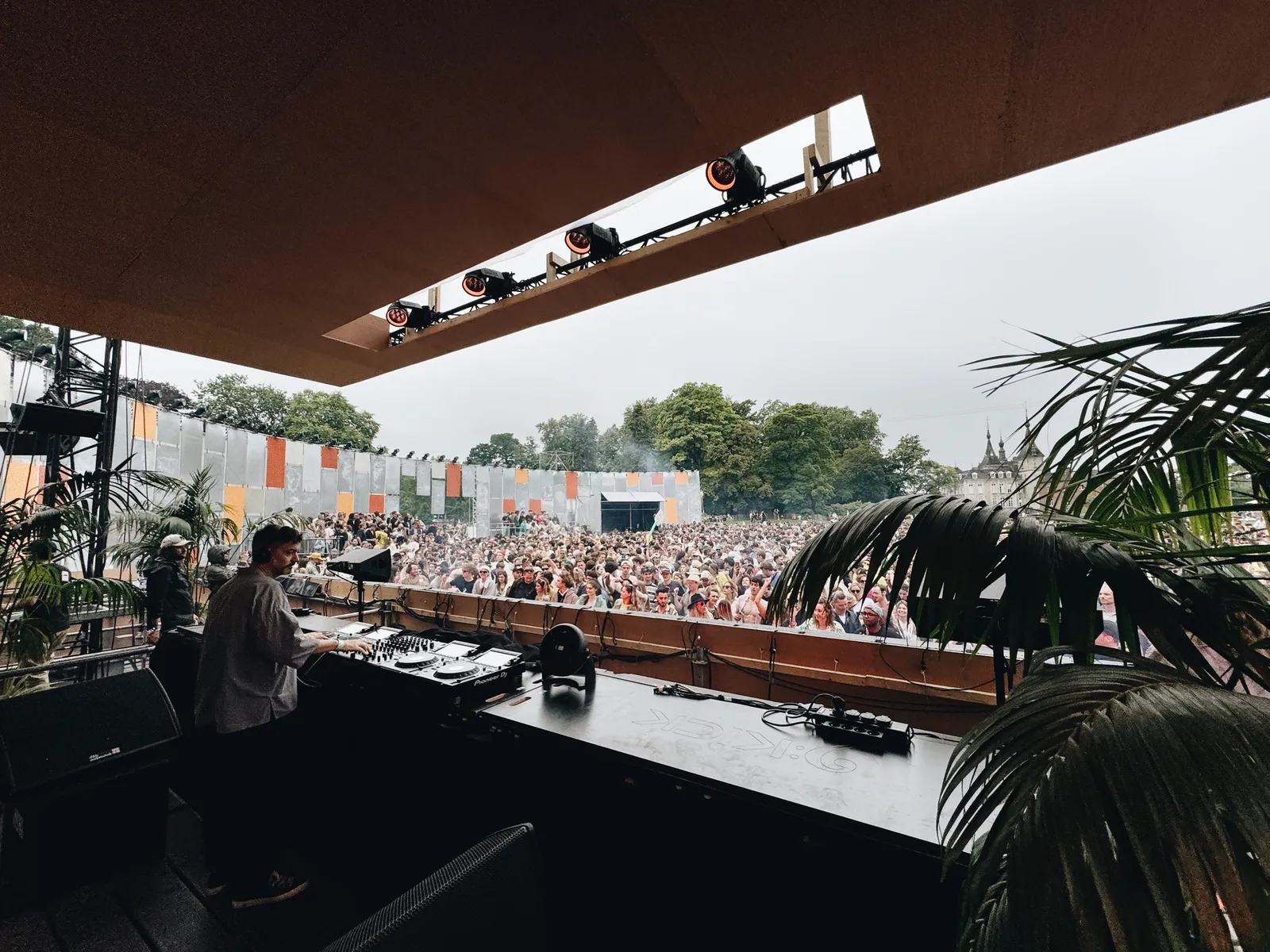
Since 2015, Paradise City has built a reputation most festivals would not dare to chase: the first cashless festival in Belgium, a fully plant-based food offer, and in 2024 the title of world’s most sustainable music festival at the AGF Awards. All of it happens around a castle in Perk, the setting visitors name as their top reason to come.
We are never going to become a festival of 60,000 people a day. We are at 16,000 a day now, official numbers. It is a small, cosy festival and it has to stay that way.
— Nick Verheyden, Head of Operations Paradise City 2015 to 2025, co-founder Eventication
Behind the festival are crew, suppliers, artists, press and food trucks. The operations team coordinates the information and access each group needs across the event.
The early registration process
In the early editions, Nick and his colleagues worked with paper records and spreadsheets.
Volunteers emailed the festival, received a Word document and sent it back; every answer was copied into Excel by hand. At 300 volunteers and five to six minutes per person, that alone was more than 30 hours of administration. “And I think we are underestimating that,” Nick says. “It was probably a lot more.”
The planning happened at his kitchen table: three or four people, three or four evenings, until two or three in the morning, writing names on large sheets of paper. “The very first year we crumpled up the whole planning after night one and threw it in the bin. It did not work. We started again the next day with a different system.”
At check-in, colleagues used separate spreadsheets to record arrivals. Paper contracts were signed at the gate and kept in ring binders.
Zone control barely existed: a few wristband colours, no scanning. During one show, a call came in: far too many people behind the main stage. “You go and look, and there are a hundred people standing there. Maybe ten of them have the right wristband. The other ninety just wandered in through the emergency exits.”
Catering teams worked from estimated numbers, with limited records to compare against collection and invoices afterwards.
After the festival, the team entered volunteer payments individually in the bank, then followed up on account details and payment questions.
Stress and fear. Those are the two words. And then Sunday night, eleven o’clock: euphoria.
Nick Verheyden on the feeling of those years.
The euphoria did not fix anything. One colleague told him plainly: “Guys, if it is like this again next year, I am not coming back to help.”
The team wanted a shared record that could support registration, check-in and the work that followed.
Starting with registration and planning
The tipping point was check-in. Four lists, four answers to the same question: is this person actually here? “You could not find people. Has he worked or not? Do we pay him or not?” Without reliable check-in data, paying people became guesswork, a line an organiser does not want to cross.
Sam, a developer in the team, offered a way out: “I will write something small for you.” That something small became FestiDB, Festival Database: a registration form and a basic planning tool for exactly one festival. Nick still logs into the platform with his old festidb.com account.
FestiDB grew as the team added workflows and other organisers began using it. In 2019, the internal tool became the company Eventication.
A note on the double role
Nick Verheyden co-founded Eventication and led operations at Paradise City until 2025, when he handed over the role to focus on Eventication. He remains involved in safety, permits and local relations. His account describes the work at a festival where he helped build and use the platform.
How Paradise City runs today
Crew management
Crew choose availability and shifts
Volunteers register online and share availability or shift choices. The operations team reviews the planning and adjusts assignments where needed, working with individual volunteers and associations.
Accreditation on site
Using a shared record at check-in
At arrival, staff scan a ticket to find the person’s record and prepare a wristband. Access, documents and rewards are connected to that record, with actions depending on the event’s configuration.
Supplier portal
Suppliers manage their own people
Suppliers got their own portal with limits set by the festival, where they enter their own people, vehicles and meal requests. If someone falls ill, the supplier swaps the name, no phone call needed. When a food truck’s inspection certificate is about to expire, the system flags it a month in advance. Nick has seen the alternative: “A fire brigade check on Thursday evening, certificate expired, and that truck stood closed for three days. Now we catch that before anyone drives onto the site.”
Stock management
Following up on outstanding equipment
Stock got the same treatment. Walkie-talkies used to vanish, 10 to 20 every year. Now every item is scanned out against a wristband and scanned back in. “In the evening our stock manager opens the list, sees what is still out, and starts calling. Where is your walkie? That is a beautiful before and after.”
Payments
Preparing a bank payment file
And the payment marathon? “After the festival we download one SEPA file and upload it to the bank. Within ten seconds, 500 payments are done.”
Explore the workflows for your event
Tell us how you manage crew, accreditation and equipment. We’ll show you how those tasks connect in Eventication.
The new process also asked people to change how they worked.
Suppliers took responsibility for entering information that the festival team had previously collected for them.
Coordinators still needed to review whether a volunteer’s chosen role was suitable.
Popular shifts filled first, and the team continued to adjust assignments when needed.
Over time, suppliers became familiar with preparing their own details before the event.
The team’s experience
Eventication gave us less work, better overview and above all better control over the whole operational side: accreditation, crew planning and stock management.
— Nick Verheyden, Head of Operations Paradise City 2015 to 2025, co-founder Eventication
The clearest measure is Nick’s phone. “Back then, two to three hundred calls a day with questions. Now I get maybe ten or fifteen, and most of those are not even about things that run in Eventication.” The authorities feel the difference too: a social inspection gets a full list of everyone on site in five clicks, and the police get live crew headcounts on request.
He is honest about the limits: “No, I do not sleep better in the week before the festival. There are always other things. But it is peace of mind to know that crew planning, accreditation and stock are simply ready.”
Paradise City could not have grown into what it is today without Eventication. If your backstage does not get more professional, your front cannot grow either. The one has to grow with the other.
— Nick Verheyden
See the workflows for yourself
1Tell us about your event
Talk us through your teams, the information they share and the tasks you want to manage.
2See the relevant features
We show those workflows in Eventication and answer your team’s questions.
3Prepare together
Agree the modules, setup, training and support that fit your event.